



Weighing chicken raw is the most accurate way to track nutrition because cooking changes its weight due to moisture loss. While some people weigh cooked chicken for convenience, this can lead to overestimating portion sizes and miscalculating calories and protein. For precision in meal planning and fitness goals, always weigh your chicken before cooking.
Key Takeaways
- Weigh chicken raw for accuracy: Raw weight reflects the true nutritional content before moisture loss during cooking.
- Cooked chicken weighs less: Grilling, baking, or frying removes water, reducing weight by 25–30% on average.
- Nutrition labels are based on raw weight: Calorie and protein counts on packaging refer to uncooked chicken.
- Weighing cooked chicken can mislead: Using cooked weight may cause you to eat more than intended, affecting calorie and macro goals.
- Consistency matters most: Whether you choose raw or cooked, stick to one method to track progress reliably.
- Use a food scale: A digital kitchen scale ensures precise measurements for both raw and cooked chicken.
- Adjust recipes accordingly: If a recipe calls for cooked chicken weight, convert it using a 1.3:1 raw-to-cooked ratio.
Quick Answers to Common Questions
Should I weigh chicken before or after cooking?
Weigh chicken before cooking for the most accurate nutrition tracking. Raw weight matches nutrition labels and accounts for moisture loss during cooking.
How much does chicken shrink when cooked?
Chicken typically loses 25–30% of its weight when cooked due to moisture evaporation. A 4-ounce raw breast may weigh about 3 ounces after cooking.
Can I weigh chicken cooked and still track accurately?
Yes, but you need to adjust. Multiply cooked weight by 1.3 to estimate the raw equivalent and log that amount in your food tracker.
Does cooking change the protein content of chicken?
No, cooking doesn’t reduce protein. It may make it more digestible, but the total amount remains the same—only the weight changes.
What’s the best way to weigh chicken for meal prep?
Weigh each piece raw before cooking, then label the container with the raw weight. This ensures accurate logging later.
📑 Table of Contents
- Are You Supposed to Weigh Chicken Cooked or Raw for Accurate Nutrition?
- Why Weighing Raw Chicken Is More Accurate
- What Happens to Chicken When You Cook It?
- Weighing Cooked Chicken: When It Makes Sense
- Practical Tips for Weighing Chicken Accurately
- Real-Life Examples: Raw vs. Cooked Weighing
- Common Myths About Weighing Chicken
- Conclusion: Raw Weighing Wins for Accuracy
Are You Supposed to Weigh Chicken Cooked or Raw for Accurate Nutrition?
When it comes to tracking your food intake—whether for weight loss, muscle gain, or general health—precision is key. One of the most common questions people ask is: *Should I weigh my chicken raw or cooked?* It might seem like a small detail, but it can make a big difference in how accurately you track your calories, protein, and other nutrients.
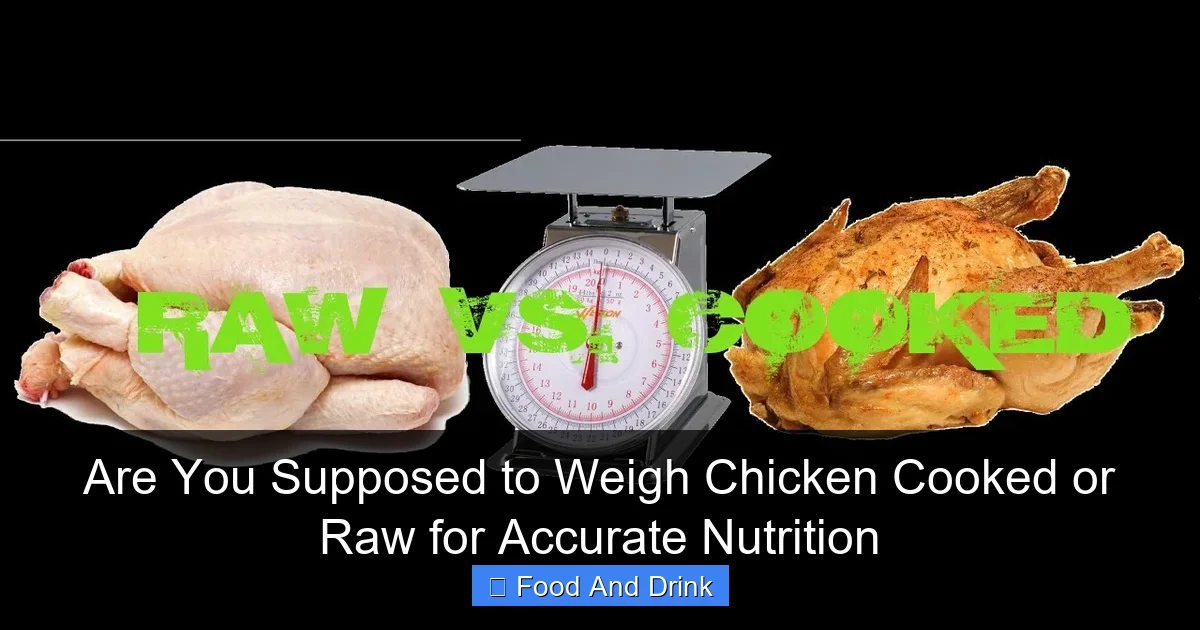
Let’s be honest—cooking chicken changes it. Whether you’re grilling, baking, pan-frying, or air-frying, heat causes moisture to evaporate. That means a 4-ounce raw chicken breast won’t weigh 4 ounces once it’s cooked. In fact, it could shrink to just 3 ounces or even less. If you’re relying on cooked weight to measure your portions, you might be eating more than you think—and unknowingly consuming extra calories and protein.
On the flip side, some people argue that weighing cooked chicken is more practical. After all, that’s what you’re actually eating. But here’s the catch: nutrition labels and databases like the USDA or MyFitnessPal list nutritional information based on raw weight. So if you weigh your chicken after cooking, you’re not comparing apples to apples. You’re trying to match a cooked apple to a raw one—and that just doesn’t work.
In this guide, we’ll break down why weighing chicken raw is the gold standard for accurate nutrition tracking, how cooking affects weight and nutrients, and what to do if you prefer to weigh your food cooked. We’ll also share practical tips, real-life examples, and expert advice to help you make the best choice for your health and fitness goals.
Why Weighing Raw Chicken Is More Accurate

Visual guide about Are You Supposed to Weigh Chicken Cooked or Raw for Accurate Nutrition
Image source: lillieeatsandtells.com
The short answer? Yes, you should weigh chicken raw if you want the most accurate nutrition data. Here’s why.
Nutrition Labels Are Based on Raw Weight
Every nutrition label on a package of chicken—whether it’s boneless, skinless breast, thighs, or ground chicken—is calculated based on the raw, uncooked weight. For example, a typical 4-ounce (113-gram) raw chicken breast contains about 120 calories and 26 grams of protein. These numbers don’t change when you cook the chicken—what changes is the weight.
When you cook chicken, you’re not adding or removing protein or calories. You’re simply driving off water. So if you start with 4 ounces of raw chicken and end up with 3 ounces after cooking, those same 120 calories and 26 grams of protein are now packed into a smaller portion. If you weigh it cooked and assume it’s 3 ounces of raw equivalent, you’ll underestimate your intake.
Let’s say you eat what you think is a 3-ounce cooked chicken breast. You log it as 3 ounces in your food tracker, which might show around 90 calories and 20 grams of protein. But in reality, that 3-ounce cooked piece came from a 4-ounce raw piece—meaning you actually consumed 120 calories and 26 grams of protein. Over time, these small discrepancies add up.
Moisture Loss During Cooking
Chicken is about 65–75% water by weight. When you apply heat, that water evaporates. The amount of moisture lost depends on the cooking method, temperature, and duration. For example:
– Grilling or baking at high heat causes faster moisture loss.
– Poaching or steaming retains more water.
– Overcooking leads to greater shrinkage.
On average, chicken loses about 25–30% of its weight during cooking. That means a 100-gram raw chicken breast could end up weighing just 70–75 grams after cooking. If you’re tracking macros for bodybuilding or weight management, that 25–30% difference can throw off your daily totals.
Consistency in Tracking
Another reason to weigh raw is consistency. If you weigh your chicken before cooking, you create a reliable baseline. You know exactly how much you’re starting with, and you can log it accurately in your food diary or app. This is especially important if you’re following a structured meal plan or tracking for medical reasons.
Imagine this: one day you weigh your chicken raw and log 4 ounces. The next day, you forget and weigh it cooked—only 3 ounces. Your tracker shows you ate less protein, but in reality, you ate the same amount. Over time, these inconsistencies can make it seem like you’re not making progress, even when you are.
What Happens to Chicken When You Cook It?
Visual guide about Are You Supposed to Weigh Chicken Cooked or Raw for Accurate Nutrition
Image source: i.ytimg.com
To understand why raw weighing is better, it helps to know what actually happens to chicken during cooking.
Physical Changes: Shrinkage and Texture
As mentioned, cooking causes chicken to shrink. This is due to the evaporation of water and the denaturation of proteins. When proteins heat up, they unravel and squeeze out moisture—like wringing out a wet sponge. This is why overcooked chicken becomes dry and stringy.
The texture also changes. Raw chicken is soft and pliable. Cooked chicken becomes firm and flaky. These physical changes are normal and expected, but they affect how we measure and perceive portion sizes.
Nutritional Changes: What Stays and What Goes
Here’s the good news: cooking doesn’t destroy protein or significantly alter the calorie content of chicken. The macronutrients—protein, fat, and carbs—remain largely intact. However, some water-soluble vitamins like B vitamins (especially B6 and niacin) can leach out into cooking water, especially if you boil or poach the chicken.
But for most people, the biggest nutritional concern is accurate tracking—not vitamin loss. And that comes back to weight. Since the nutrients are concentrated into a smaller mass after cooking, using cooked weight can lead to underestimating your intake.
Does Cooking Method Matter?
Yes, but not as much as you might think. While different methods affect moisture retention, the overall weight loss is similar across common techniques:
– **Grilling:** High heat, fast cooking, moderate moisture loss (~25–30%).
– **Baking:** Even heat, moderate loss (~20–25%).
– **Pan-frying:** Can vary—using oil may add a tiny bit of weight, but moisture loss still occurs.
– **Air-frying:** Similar to baking, with good crispness and ~25% weight loss.
– **Poaching or steaming:** Retains more moisture, so weight loss is closer to 15–20%.
Even with these variations, the key point remains: raw weight is the most reliable starting point.
Weighing Cooked Chicken: When It Makes Sense
Visual guide about Are You Supposed to Weigh Chicken Cooked or Raw for Accurate Nutrition
Image source: delishsides.com
Despite the advantages of weighing raw, there are situations where weighing cooked chicken might be more practical—or even preferred.
Convenience and Real-World Eating
Let’s face it: not everyone wants to weigh their food before cooking. Some people meal prep in bulk, cooking several chicken breasts at once. Others eat at restaurants or friends’ houses, where raw weighing isn’t an option. In these cases, weighing cooked chicken is the only realistic choice.
If you’re in this camp, don’t stress. You can still track accurately—you just need to adjust your approach.
How to Adjust for Cooked Weight
If you prefer to weigh your chicken after cooking, you can still get close to accurate nutrition numbers by using a conversion ratio. Here’s how:
1. **Know the average shrinkage rate:** As a rule of thumb, chicken loses about 25% of its weight when cooked. So, 100 grams of raw chicken becomes about 75 grams cooked.
2. **Reverse the math:** If you have 75 grams of cooked chicken, it likely came from 100 grams of raw chicken.
3. **Use a 1.3:1 ratio:** For every 1 gram of cooked chicken, multiply by 1.3 to estimate the raw equivalent.
For example:
– You weigh 3 ounces (85 grams) of cooked chicken.
– Multiply 85 by 1.3 = 110.5 grams raw equivalent.
– Log 110.5 grams (about 3.9 ounces) in your food tracker.
This method isn’t perfect—shrinkage can vary—but it’s much more accurate than logging cooked weight as raw.
When Cooked Weighing Is Acceptable
Weighing cooked chicken is fine if:
– You’re not tracking for precise goals (e.g., general healthy eating).
– You’re consistent—always weigh cooked and always use the same method.
– You’re using recipes that specify cooked weights (e.g., “add 6 ounces of cooked chicken”).
Just remember: if you’re aiming for accuracy—especially for fitness, medical, or weight-loss goals—raw weighing is still the best practice.
Practical Tips for Weighing Chicken Accurately
No matter which method you choose, these tips will help you get the most accurate results.
Use a Digital Food Scale
A good digital kitchen scale is worth its weight in gold—literally. Look for one that measures in grams and ounces, has a tare function (to zero out the bowl), and is easy to clean. Prices start around $10–$15, and they’re a game-changer for meal prep.
Weigh Before You Season or Marinate
If you’re weighing raw chicken, do it before adding oils, sauces, or marinades. These add weight and calories. For example, a tablespoon of olive oil adds about 120 calories. If you weigh the chicken after marinating, you’ll include those extra calories—but they’re not part of the chicken itself.
Instead, weigh the plain chicken, log it, then add the marinade or oil separately in your tracker.
Be Consistent
The most important thing is consistency. If you decide to weigh raw, stick with it. If you prefer cooked, use the conversion method every time. Mixed methods lead to confusion and inaccurate tracking.
Label Your Meal Prep
If you cook chicken in bulk, label each portion with the raw weight. For example: “4 oz raw, baked.” This way, you can log it correctly later—even if you’re eating it days later.
Use Reliable Nutrition Databases
Not all food databases are created equal. Use trusted sources like:
– USDA FoodData Central
– MyFitnessPal (with verified entries)
– Cronometer
These databases list nutrition info based on raw weight, so they align with your raw measurements.
Real-Life Examples: Raw vs. Cooked Weighing
Let’s look at a few scenarios to see how raw and cooked weighing play out in real life.
Example 1: Meal Prep for the Week
Sarah meal preps 5 chicken breasts for her lunches. Each raw breast weighs 4 ounces (113 grams). She bakes them and stores them in containers.
– **If she weighs raw:** She logs 4 oz per serving = 120 calories, 26g protein.
– **If she weighs cooked:** Each breast now weighs 3 oz. She logs 3 oz = 90 calories, 20g protein (incorrect).
Over 5 days, she underestimates her protein by 30 grams and calories by 150. That’s a significant error for someone tracking macros.
Example 2: Eating Out
Tom eats at a restaurant and orders a grilled chicken salad. The menu says “6 oz grilled chicken.” Since it’s cooked, he can’t weigh it raw.
– He estimates 6 oz cooked ≈ 8 oz raw (using 1.3:1 ratio).
– He logs 8 oz raw = 240 calories, 52g protein.
– If he logs 6 oz cooked as raw, he’d log 180 calories, 39g protein—underestimating by 60 calories and 13g protein.
Not perfect, but closer to the truth.
Example 3: Following a Recipe
Lisa is making chicken stir-fry. The recipe calls for “1 lb cooked chicken, diced.”
– She cooks 1.3 lbs (20.8 oz) raw chicken to get about 1 lb cooked.
– She logs 20.8 oz raw = 624 calories, 135g protein.
– If she only logs 16 oz (1 lb) as raw, she’d be off by over 150 calories and 30g protein.
By adjusting for shrinkage, she stays on track.
Common Myths About Weighing Chicken
Let’s clear up some misconceptions.
Myth 1: “Cooking Destroys Protein”
False. Cooking makes protein more digestible by breaking down its structure. It doesn’t reduce the amount of protein—just changes its form.
Myth 2: “Weighing Cooked Is More Realistic”
While it reflects what you eat, it’s less accurate for tracking. Realism doesn’t equal precision.
Myth 3: “All Chicken Shrinks the Same”
Not quite. Fat content, cooking method, and doneness affect shrinkage. But the 25–30% average is a solid guideline.
Myth 4: “You Can’t Track Without a Scale”
You can estimate using hand sizes (e.g., palm = 3–4 oz), but a scale is far more accurate.
Conclusion: Raw Weighing Wins for Accuracy
So, are you supposed to weigh chicken cooked or raw? For the most accurate nutrition tracking, the answer is clear: weigh it raw.
Raw weight gives you a true baseline that matches nutrition labels and databases. It accounts for moisture loss during cooking and helps you log calories and macros correctly. While weighing cooked chicken is more convenient in some situations, it requires adjustments to avoid underestimating your intake.
The bottom line? If you’re serious about your health, fitness, or weight goals, invest in a food scale, weigh your chicken before cooking, and log it accurately. Your future self—and your progress tracker—will thank you.
And remember: consistency is key. Whether you choose raw or cooked, stick with one method and use reliable data. Small habits lead to big results.
🎥 Related Video: Should you weigh your food RAW or COOKED?
📺 ryanfischer
Frequently Asked Questions
Why is raw weight more accurate than cooked weight?
Raw weight reflects the true nutritional content before cooking. Nutrition labels are based on raw weight, and cooking only removes water, not calories or protein.
Can I use volume measurements instead of weight?
Volume (like cups) is less accurate because chicken density varies. A food scale gives precise measurements for better tracking.
What if I forget to weigh my chicken raw?
If you only have cooked chicken, estimate the raw weight by multiplying cooked weight by 1.3. It’s not perfect, but better than guessing.
Does freezing affect chicken weight?
Freezing adds ice, which increases weight slightly. Weigh chicken after thawing for the most accurate raw measurement.
Should I weigh chicken with or without bones?
Weigh boneless chicken for accuracy. Bone-in chicken includes inedible parts, which can skew your nutrition data.
Is it okay to estimate chicken portions without a scale?
You can use your palm (about 3–4 oz), but a scale is far more precise—especially for tracking calories and macros.


